
News
Zafran Team
Zafran Announces Strategic Investment from Amex Ventures
February 24, 2026
First JPMorgan, now FS-ISAC. The financial sector's message to VM teams: accelerate to CTEM before the patch-to-exploit window closes on you.
On April 20, FS-ISAC published a Sector Risk Advisory titled Preparing the Enterprise for AI-Enabled Vulnerability Discovery. The advisory opens with a statement that should stop every financial services CISO in their tracks:
"Traditional assumptions and approaches for vulnerability management no longer hold."
This is the second major post-Mythos directive from the financial sector in two weeks. JPMorgan Chase, a Project Glasswing participant, published its own 10-action letter on AI-ready cyber resilience on April 17. Now FS-ISAC, the sector's primary threat intelligence sharing organization, representing thousands of financial institutions globally, is reinforcing the same message with even sharper language. When the industry's largest bank and its collective intelligence body converge on the same conclusion within days of each other, the signal is clear.
And the conclusion is the same: vulnerability management as the industry has practiced it is insufficient for the threat environment Mythos-class AI models are creating. FS-ISAC frames this explicitly as "a fundamental shift in operations to manage cybersecurity and resilience risks." For VM teams, this is another mandate to accelerate the transition to Continuous Threat Exposure Management (CTEM).
The urgency is palpable throughout the advisory. FS-ISAC warns:
"We have an unknown window before threat actors have access to the new capabilities and we need to move with speed to address what is known while preparing to change our processes for the long haul."
That unknown window is closing. Here is what the advisory demands across the four functions every VM team owns.
FS-ISAC calls for a "real-time asset inventory, including dependencies and connections, to support same-day decisioning as risks emerge." Same-day decisioning. That is a significant step beyond JPMorgan's"minutes, not days" bar for answering "where are we exposed?"
The advisory also calls out what many organizations treat as acceptable tech debt: end-of-life software and hardware. FS-ISAC's reasoning is blunt:
"AI-assisted tools can rapidly identify which software versions an organization is running and immediately cross-reference known vulnerabilities for those versions. Outdated systems are essentially pre-labeled targets."
The detection mandate is clear. Organizations need continuous, comprehensive visibility across their environments, including third-party dependencies and internet-facing exposures, and they need it maintained in real time, not reconciled quarterly.
This is where FS-ISAC departs most sharply from legacy VM thinking. The advisory tells teams to
"update vulnerability prioritization processes to assume active or imminent exploitation of every vulnerability by default."
Every vulnerability. By default. That is a radical reframing. Traditional prioritization models rely on CVSS scores and exploit availability data to filter the backlog down to a manageable number. FS-ISAC is saying that model is broken because AI eliminates the constraints that made it work. As the advisory puts it:
"Traditional vulnerability scoring and remediation timelines were designed when exploit development took longer and adversaries had to make choices about where to focus effort. AI eliminates these constraints, including weaponizing vulnerabilities that were previously considered low priority."
The practical guidance follows: assign greater weight to externally facing vulnerabilities regardless of past exploitation history, move beyond CVSS-only scoring, compress remediation SLAs to days rather than weeks, and automate prioritization decisions so that the most severe findings reach the right teams immediately.
FS-ISAC compresses the timeline expectations further than JPMorgan did. The advisory calls for organizations to
"compress remediation service level agreements (SLAs) to days, not weeks, and automate prioritization decisions to ensure the most severe findings get to the right teams immediately."
The advisory also frames vulnerability backlogs differently than most security teams are used to. FS-ISAC tells organizations to
"treat vulnerability backlogs as operational risk, not compliance debt" and to "set expectations across business, technology, cybersecurity, and resilience leadership that prioritize burn-down over non-critical updates, upgrades, and product launches."
That last point is significant: FS-ISAC is telling financial institutions to deprioritize product launches in favor of vulnerability remediation. That kind of trade-off only gets made when the risk is existential.
The advisory reinforces this with an accountability mandate:
"Build security metrics into team objectives, measuring system owners' patch velocity and platform currency on par with system performance. Treat remediation speed as a reliability metric, reporting to governance committees and the Board of Directors as part of operational risk."
FS-ISAC's sixth recommendation carries the most consequential framing in the entire advisory. It tells organizations to
"shift mindset from vulnerability management to exploit prevention."
That single phrase captures a transformation that has been building across the industry and that the Mythos moment has made urgent.
The reasoning is direct:
"AI-assisted attacks move faster than human response teams can track. Strategies dependent on detection and reactive remediation will fall behind."
The advisory calls for organizations to block exploits in progress through WAFs, intrusion prevention systems, runtime application protection, and other controls that intervene rather than observe. It calls for network segmentation, access controls, and isolation between systems. And it urges organizations to harden the perimeter preemptively: expand WAF capabilities, modernize perimeter defenses, and put more distance between attackers and systems using CDNs, managed hosting, and cloud edge controls.
This is the same preemptive mitigation thesis we outlined in our JPMorgan analysis. Waiting for a disclosure to trigger a mitigation response is already too slow. Organizations need to fortify compensating controls now, ahead of the disclosure wave, so that when the next batch of AI-discovered CVEs drops, their environments are already hardened.
Every recommendation in the FS-ISAC advisory maps to capabilities Zafran delivers today.
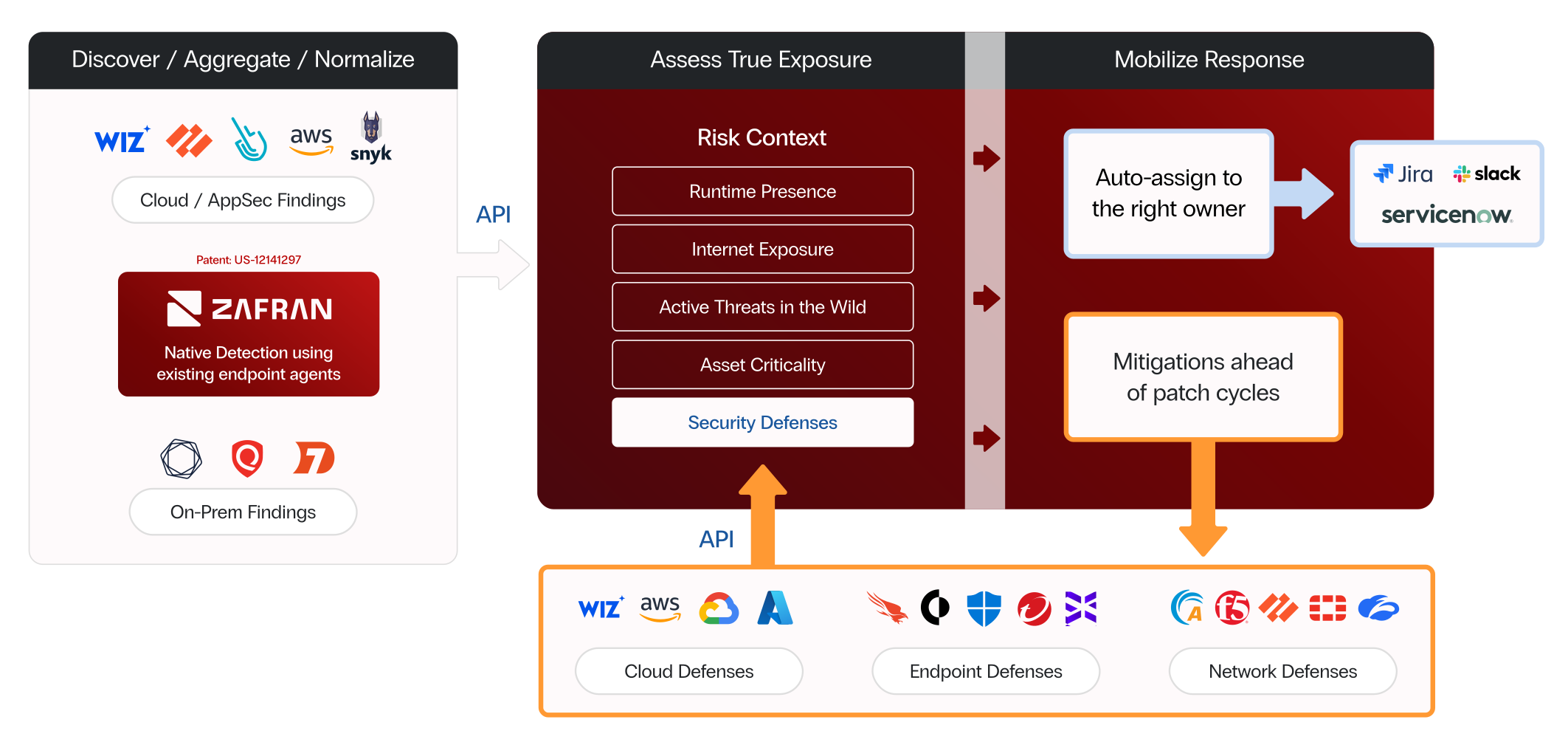
Zafran unifies cloud, on-prem, and AppSec findings into a single, continuously updated view of exposure, including third-party dependencies and internet-facing assets. Zafran also performs continuous detection using SBOM data to identify vulnerable components ahead of formal CVE enumeration, giving teams a head start before advisories are even published. The real-time asset visibility and same-day decisioning FS-ISAC demands becomes a standing capability rather than a project.
Zafran assesses true exposure by correlating every finding with runtime presence, internet reachability, active threats in the wild, asset criticality, and the state of your existing security defenses. When FS-ISAC tells teams to assume every vulnerability will be exploited, the question becomes: which ones are actually exploitable in my environment right now? That is the question Zafran's risk context answers, cutting through the noise that CVSS-only scoring creates.
Zafran mitigates preemptively by mapping every exposure to the compensating controls already deployed in your environment. When FS-ISAC calls for a shift from vulnerability management to exploit prevention, Zafran is the platform that operationalizes that shift, identifying which WAF rules, EDR policies, and network controls already protect you, where gaps remain, and pushing mitigation policies to close those gaps ahead of patch cycles.
Zafran mobilizes remediation by consolidating overlapping CVEs into focused actions, auto-assigning work to the right owners, and routing tasks through Jira, Slack, and ServiceNow with SLA tracking. When FS-ISAC calls for SLAs compressed to days and remediation speed treated as a board-level reliability metric, Zafran provides the measurement and automation infrastructure to make that real.
Gartner recently identified Zafran as the only vendor among ~150 startups in the exposure management space that delivers this full lifecycle natively in a single platform.
The architecture below shows how these capabilities connect end to end, from discovery through autonomous response.
Two of the most authoritative voices in financial services have now converged on the same conclusion within days of each other. JPMorgan's letter outlined the operational playbook. FS-ISAC's advisory reinforces it and raises the bar further: assume every vulnerability will be exploited, compress SLAs to days, shift from vulnerability management to exploit prevention, and treat remediation speed as a board-level metric.
This is not a moment for incremental improvement. The financial sector is being told, by its own institutions and its own intelligence body, to fundamentally change how it manages vulnerability risk. The organizations that act on that signal now will be the ones that weather the Mythos transition. The ones that wait will find themselves further behind with every disclosure cycle.
Traditional vulnerability management must change. So many are drowning in detections, and still lack insights. The time-to-exploit window sits at 5 days. Implementing a Continuous Threat Exposure Management (CTEM) program is the path forward. Moving from vulnerability management to CTEM doesn't have to be complicated. This guide outlines steps you can take to begin, continue, or refine your CTEM journey.