Blog
Nate Rollings
After PHP2Shell: How CISOs Can Be Ready for the Next Zero-Day
October 27, 2026
A critical CVE drops into the remediation queue tagged for a business-critical, internet-facing server, and it jumps straight to the top of the sprint. A team commits real hours to patching it, coordinating a maintenance window, briefing the asset owner, and working through the patch end-to-end. But the exploit needs something this machine doesn't have, like a specific driver or hardware feature, so the conditions for exploitation are never actually met. The team spends hours defending against a risk that was never real.
This happens more often than most teams realize. The scanner flagged the server because its software version matched an advisory, and nothing in that match said whether the exploit could run on that machine. Context mismatch is how Zafran catches these cases before they reach the queue.
Most scanners identify potentially vulnerable software based on package names and version information. They retrieve this data from an inventory or a service banner, then compare it to the version range in an advisory. If the installed version falls inside the advisory’s affected range, the finding goes into the queue at whatever severity the advisory carries. That’s a reasonable first pass, and it’s also where the process usually stops, because a version string is all the scanner has to go on. Two machines running the same version look identical to it, no matter how differently they’re configured or what hardware they run on.
A CVE advisory is really a checklist of conditions that all have to be true at once for an exploit to work. A version string can’t tell you whether the vulnerable code path is reachable, whether a required module is actually loaded, or whether the CPU the asset runs on even supports the instruction set the exploit depends on. So the backlog fills with findings that share a CVE number but not a real risk profile. Even with additional prioritization signals such as business criticality, internet exposure, and runtime context, one question stays open: can the vulnerability actually be exploited on that asset? The scanner confirmed it was present, but never whether it could run.
Context mismatch asks a more specific question than CVSS, runtime status, or exposure ever does: given this exact CVE and this exact asset, can the exploit actually run here?
A context mismatch is a finding where at least one condition an exploit requires, such as a specific architecture, a driver, or a system role, is absent on that asset. Context mismatch is how Zafran validates whether a finding can be exploited on a given asset.
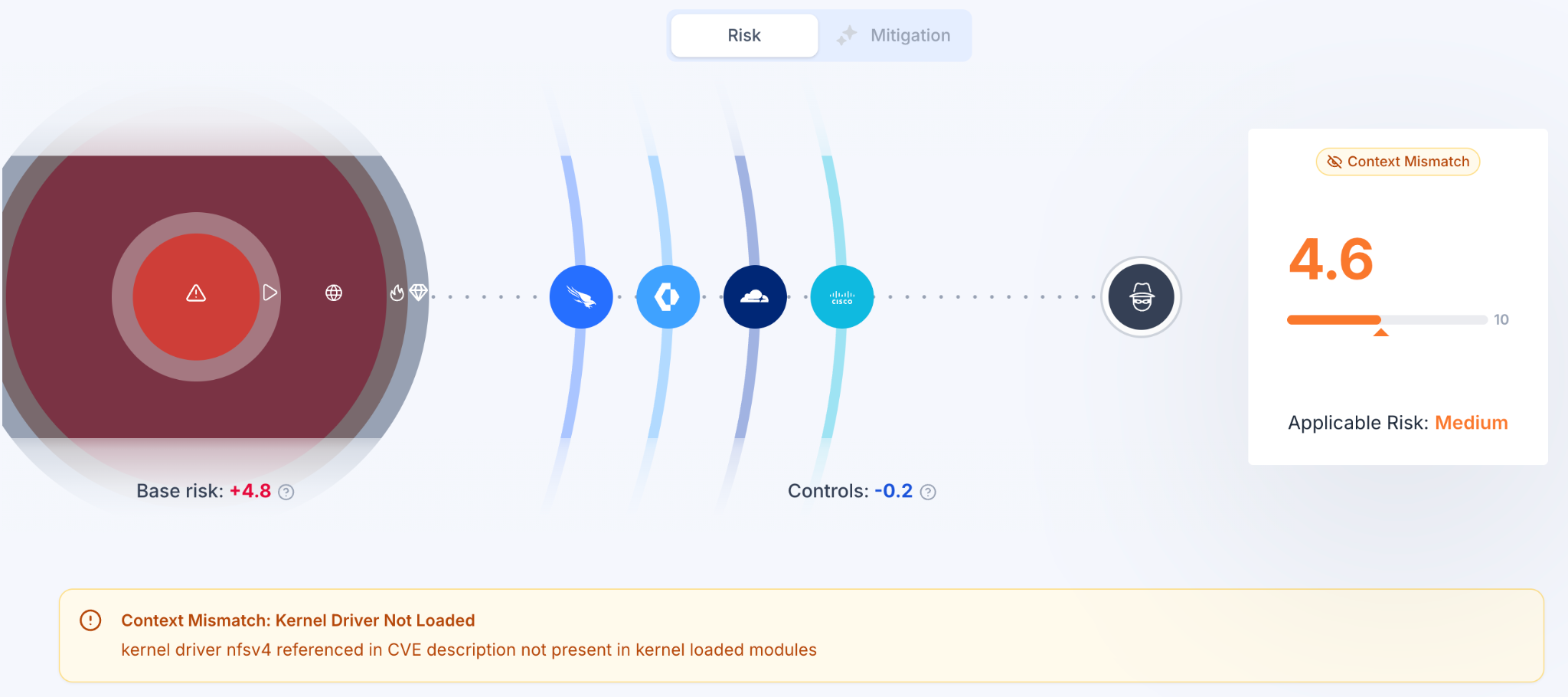
Zafran uses AI to read each advisory, along with the underlying patch or source where needed, the way a researcher would. It extracts every technical condition an exploit requires, including those that have nothing to do with the version range. Two well-known examples show what those conditions look like. A 2023 OpenSSL bug (CVE-2023-4807) only affected 64-bit Windows machines whose CPUs support a specific, uncommon instruction set, a combination plenty of environments never meet. EternalBlue, the exploit behind WannaCry, only worked when an outdated network protocol, SMBv1, was left turned on. Neither condition shows up in the software’s version number.
Zafran then checks each condition against the real asset. Some of that data comes from a standard scan. The rest, like whether a specific Windows feature is enabled on a given machine, needs direct visibility into the machine, which a standard scan doesn’t provide. A single unmet condition is enough to confirm a mismatch.
How should an organization treat a confirmed mismatch? Keep it visible, because configurations can change, and keep it out of the remediation pipeline. In Zafran, these findings receive a zero score: unexploitable. The finding and the reasoning behind it stay on record, so a team can explain the call to an auditor or a skeptical stakeholder.
Version-only scoring is least reliable on large, heavily configurable software, where a single version number can represent thousands of possible builds and configurations, all reporting the same banner to a scanner. NGINX makes the case well.
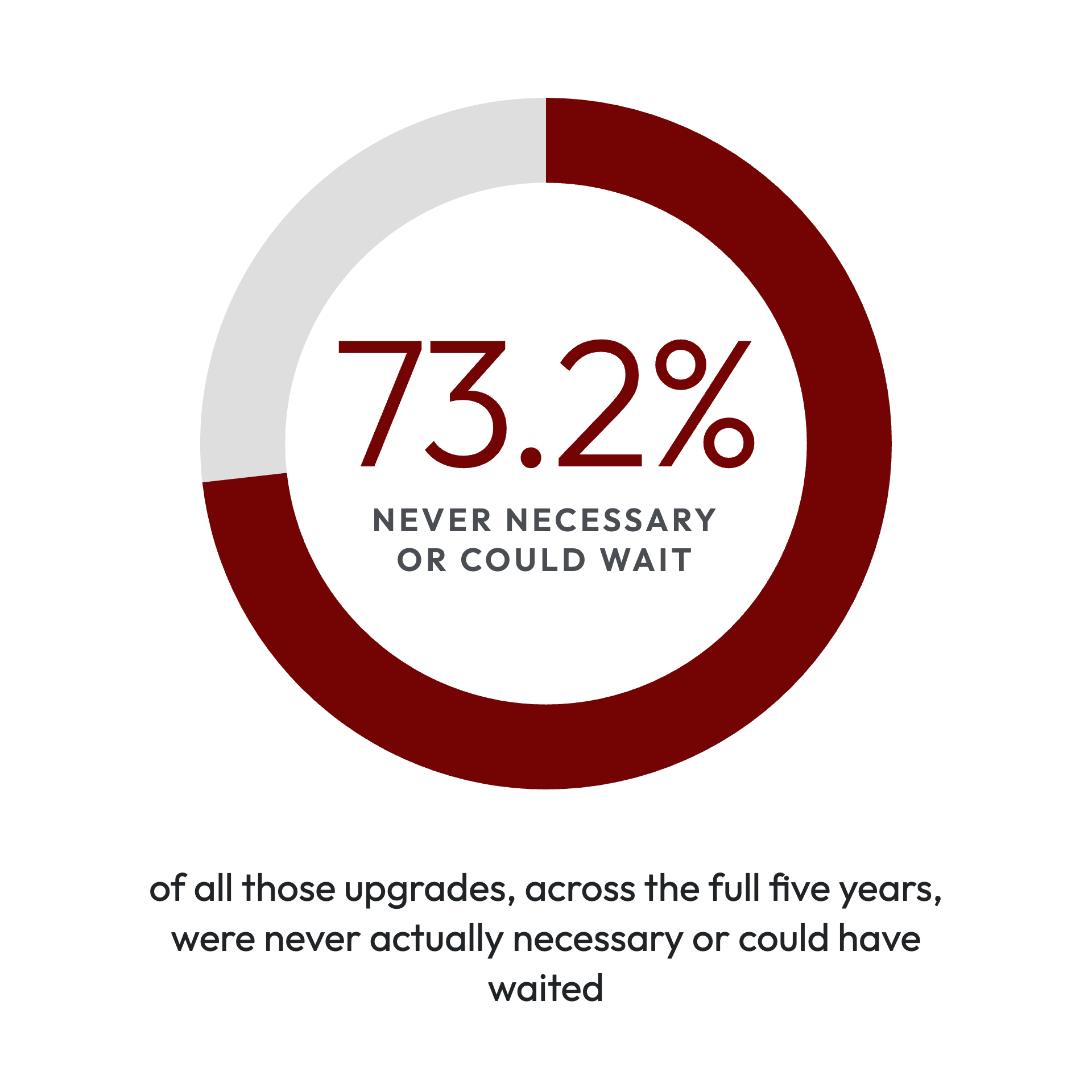
We ran context mismatch against NGINX’s patching history from 2021 through August 2026, checking every disclosed CVE’s preconditions against actual production configurations. Here’s what came back:
Nearly three out of every four NGINX security upgrades in that period cost maintenance windows, regression risk, and engineering hours for patches those assets did not need at the time. That’s the gap context mismatch is built to close, on NGINX and anywhere else scanners treat the presence of software as proof it can be exploited.
Vulnerability management has spent years getting better at ranking findings. Severity, exposure, runtime status, and threat intelligence all help a team decide what to fix first, but a ranked list still assumes every item on it is a real problem. The industry is moving toward validating each finding’s exposure before it earns a place in the queue. Context mismatch is one of the ways Zafran validates exploitability, testing whether a CVE’s technical conditions are met on a specific asset. Findings with an unmet condition come out of the remediation pipeline, and the team’s time goes to the vulnerabilities that can be exploited in their environment.
Traditional vulnerability management must change. So many are drowning in detections, and still lack insights. The time-to-exploit window sits at 5 days. Implementing a Continuous Threat Exposure Management (CTEM) program is the path forward. Moving from vulnerability management to CTEM doesn't have to be complicated. This guide outlines steps you can take to begin, continue, or refine your CTEM journey.