Blog
Amir Shavitt
Zafran and Athena: Turning the First Wave of AI-Discovered Vulnerabilities into Protection
September 29, 2026
Every system, every scanner, every security tool - each is generating more findings, more alerts, more “critical” items than any human can meaningfully process. The promise of visibility has given way to a flood of noise.
In the middle of this overload, defenders are still expected to make high-speed, high-accuracy decisions. They’re still expected to figure out which of the tens of thousands of findings discovered this week might actually lead to an incident. They’re still expected to correlate signals from a dozen data sources, validate exploitability, understand business context, run down asset owners, create tickets, follow up repeatedly, explain impact to leadership, and pray they didn’t miss the one exposure that actually matters.
Meanwhile, attackers are evolving at a terrifying pace. AI-powered exploitation is no longer theoretical, it’s already happening. Anthropic recently disclosed a state-sponsored campaign using AI agents to automate cyber-espionage across major companies and government agencies. Malicious models can weaponize new vulnerabilities within minutes, and automated kits can fingerprint infrastructure in seconds. The gap between a CVE dropping and exploitation is collapsing toward zero.
The traditional operating model: manual investigation, manual correlation, and even semi-automatic workflows, simply cannot keep up.
This is why we’re introducing Agentic Exposure Management, a new paradigm designed for the era of AI-driven threats. Rather than forcing humans to sift through mountains of data, Agentic Exposure Management uses autonomous agents that can discover exposures, interpret risk signals, validate exploitability, and initiate remediation actions with unprecedented scale and precision.
It’s the shift from endless data collection to decisive action - from manual, human-only workflows to a faster human-AI collaboration.
AI workflows don’t emerge out of thin air. They depend on an underlying data model that understands the environment better than any individual tool ever could.
From the beginning, we made a deliberate choice: exposure management can only be solved with deep, unified context, not by stacking more dashboards on top of each other. That led us to create something foundational -
the Zafran AI-Native Exposure Graph.
The Exposure Graph consolidates everything that matters: asset inventories, vulnerability findings, cloud resources, configurations, runtime signals, compensating controls, internet exposure, EDR coverage, threat intel feeds, and more. With AI-driven correlation layered on top of deep integrations, it doesn’t just collect data - it structures it, relates it, and enriches it with real risk context. We’ve also been able to scale integration development and correlation using AI - connecting systems faster, mapping relationships automatically, and understanding how different signals relate to each other, saving many months of manual engineering work.
This is the backbone that allows agentic AI to make decisions that are accurate, reliable, and specific to each environment. Without this, AI would hallucinate, oversimplify, or recommend actions without understanding operational reality. With it, every agentic workflow operates on top of a contextual model that mirrors the real world.
And because Zafran integrates with the entire security stack, the Exposure Graph stays continuously updated. It interprets signals from dozens of sources as one cohesive system.
Since we built this foundation first, AI can finally boom: unlocking agentic workflows that operate with real context, scale effortlessly, and open the door to entirely new ways of finding and fixing exposure across the environment.
For more than a decade, security teams have been promised automation, yet most organizations ended up with fragile playbooks, half-adopted SOAR deployments, and workflows that only a handful of experts knew how to operate. The core problem wasn’t ambition, it was complexity. Building automation required deep familiarity with every tool’s API, every data schema, every exception path, and every operational edge case. Maintaining those automations required even more effort, as environments evolved, integrations changed, and new threats emerged. What began as an efficiency initiative often turned into an expensive, high-friction engineering project that only senior architects could support. As a result, automation remained limited, brittle, and impossible to scale.
Agentic AI fundamentally changes this equation. Instead of relying on manually engineered playbooks, agentic systems can adapt to new signals, tools, or configurations without requiring humans to rewrite logic or maintain giant libraries of if/else conditions. Most importantly, they democratize automation: you no longer need a specialized SOAR engineer to create value. With AI, every analyst can create and benefit from powerful, context-aware automations that continuously refine themselves. Agentic AI lowers the barrier to creation, eliminates the maintenance burden, and turns automation into a living capability - one that grows smarter, not more fragile, with time.
For years, understanding an organization’s true exposure required deep expertise and countless hours of manual effort. Hunting for toxic combinations, correlating signals, piecing together evidence, and interpreting threat intel were disciplines reserved for the most experienced analysts - the people who knew where every dataset lived, how systems communicated, how scanners behaved, and which signals actually mattered. Everyone else had to wait: wait for answers, wait for reports, wait for context.
Agentic Exposure Management changes this completely.
AI agents close the skills gap. Anyone, from analysts to engineers to CISOs, can surface deep, organization-wide insights without needing to be an expert in where the data lives or how to interpret it. For the first time, understanding exposure scales with the company, not with the size of the security team.
Because the agent understands the structure and behavior of your environment - how assets relate, which resources matter, where misconfigurations create risk, and which vulnerabilities tie to active exploitation - teams no longer need to manually join scan results with CMDB metadata or correlate threat intel with SBOM artifacts.
Zafran’s agentic AI turns zero-day response from reactive scrambling into proactive resilience by modeling exposure at the component level using SBOM inventory and dependency intelligence to locate affected libraries and packages across your environment. AI agents then correlate threat intelligence, runtime signals, and exposure paths to identify assets at risk from newly emerging vulnerabilities, even before a scan is conducted.
What once required manual investigation, hours of correlation, and carefully crafted queries now happens continuously and autonomously, with insights delivered instantly. Simply ask: “Show me my most exploitable vulnerabilities.”
Zafran responds with context-rich answers that drive immediate action. In a single query, Zafran’s AI can help you correlate vulnerabilities, internet reachability, control misconfigurations, and critical-asset context to surface toxic combinations of exposures most likely to be exploited right now.
However, discovering risk is only half the battle. Eliminating it consistently, correctly, and quickly is where most organizations struggle. Friction points are everywhere: ownership debates, endless ticket cycles, uncertainty about exploitability, conflicting severity ratings, and constant back-and-forth trying to determine what actually needs to happen.
This is where Agentic Remediation™ becomes transformative.
Once an exposure is identified, an AI Agent can evaluate its exploitability using live environmental signals. It determines whether the vulnerability is reachable, whether compensating controls neutralize the risk, whether runtime behavior indicates active use, and whether the asset sits on an exposed network path.
If the business chooses to accept risk, the agent follows the organization’s guardrails and generates a complete risk-acceptance package containing justification, residual risk, evidence, and references - standardizing a process that historically took hours and varied wildly from case to case.
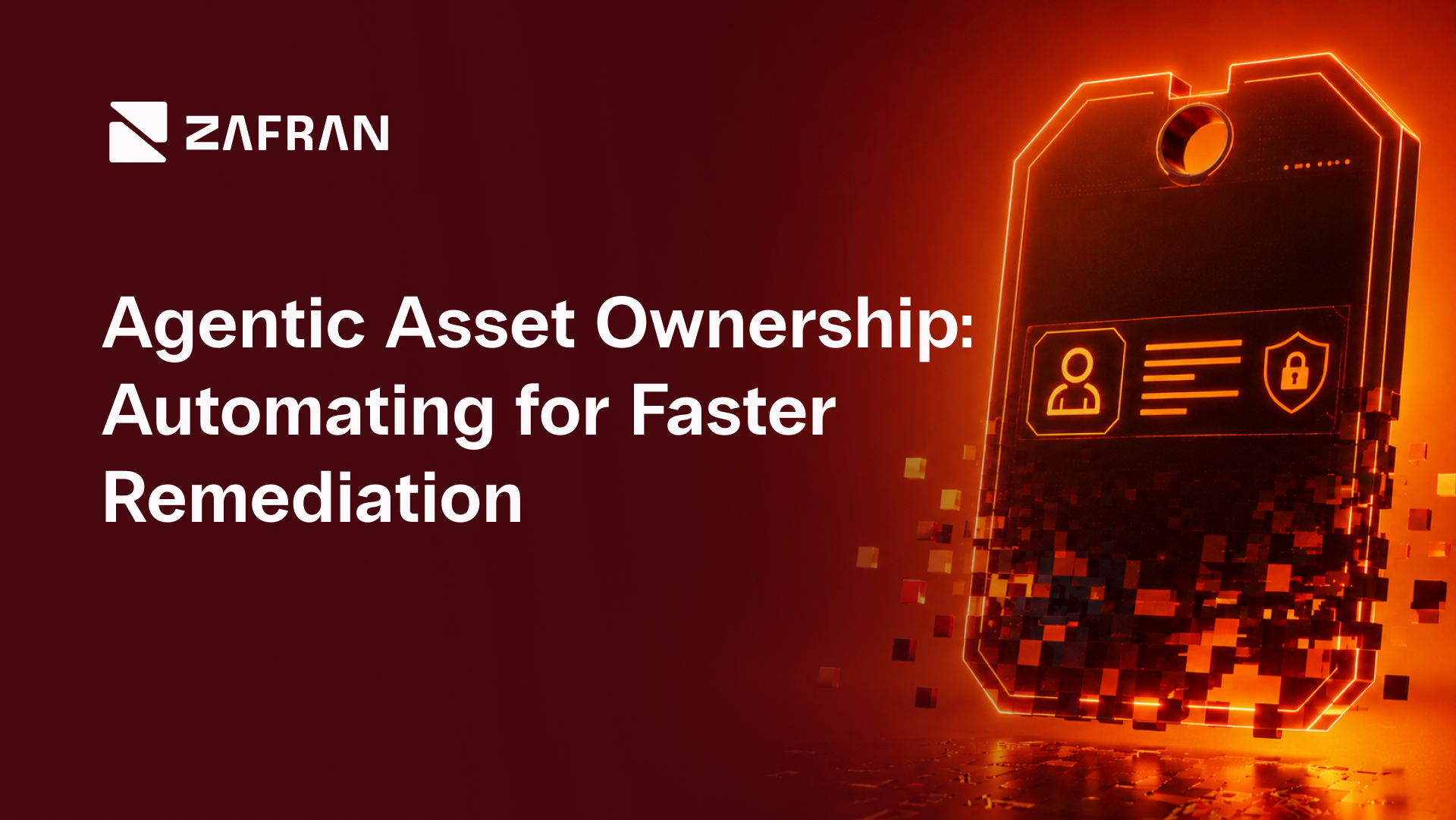
Once action is required, the agent identifies the correct owner using multiple live signals (and not just potentially outdated CMDB fields). Last-login traces from EDRs, OS-level traces, cloud IAM relationships, asset naming conventions, and change-management history turn ownership into an evidence-driven answer rather than a recurring debate.
The agent also performs impact analysis upfront, understanding dependencies, service relationships, potential blast radius, and how much downtime is expected - ensuring teams know exactly what a remediation action affects before execution.
Finally, the agent synthesizes a complete remediation plan. It deduplicates redundant instructions, consolidates overlapping recommendations, assigns the correct ticket to the appropriate owner, attaches all necessary evidence to facilitate action, and generates reports that track SLAs, MTTR, and exposure reduction with minimal manual effort.
Automate the compliance and communication layer your team dreads. Zafran’s automated reporting layer delivers the ability to generate evidence-backed reports with timestamps, validation data, and resolution context, giving executives and auditors a single source of truth for exposure management.
Agentic Exposure Management unifies insights and actions into a single, coherent operating model, where continuous discovery, contextual analysis, and intelligent remediation flow seamlessly together. It delivers a breathing system that interprets risk, validates reality, identifies ownership, and drives resolution at a speed and scale that human-only workflows could never achieve.
This is what it looks like when exposure management finally operates at the pace modern threats demand.
Agentic Exposure Management represents a shift in how cybersecurity teams operate. It’s no longer about navigating ten different tools or running manual investigations across endless datasets. It’s about having intelligent agents that understand your environment holistically -agents that can surface exposures, interpret risk, validate reality, identify ownership, draft remediation plans, and keep everyone aligned without waiting for human bandwidth.
Attackers are already using AI to shrink the time between discovery and exploitation.
Defenders now have an AI-driven operating model that compresses the time between discovery and remediation.
This is the future of Exposure Management.
The next evolution of the Zafran AI-native platform is here.
With Agentic Exposure Management, your team can finally move at the speed modern threats demand -discovering, analyzing, and resolving exposures in a seamless, intelligent, and deeply contextual flow.
Let’s eliminate risk - together.
Traditional vulnerability management must change. So many are drowning in detections, and still lack insights. The time-to-exploit window sits at 5 days. Implementing a Continuous Threat Exposure Management (CTEM) program is the path forward. Moving from vulnerability management to CTEM doesn't have to be complicated. This guide outlines steps you can take to begin, continue, or refine your CTEM journey.