Blog
Jules Gross
Agentic Asset Ownership: Automating for Faster Remediation
September 1, 2026
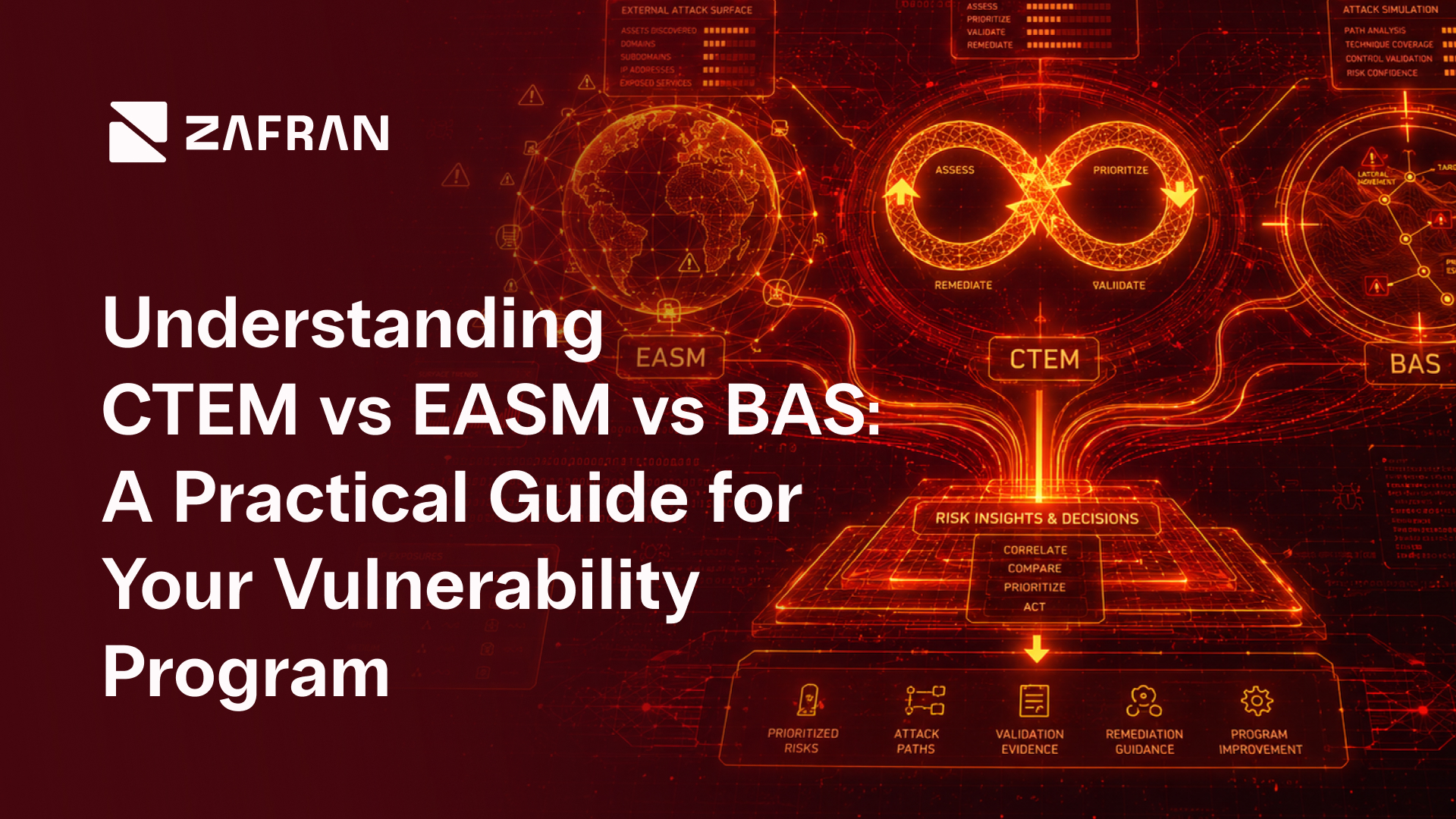
Every vulnerability management program is under pressure to mature. Leadership wants risk reduction, not a bigger spreadsheet of findings. The market answers that pressure with acronyms: CTEM, EASM, BAS, and now AEV. For a practitioner trying to actually make the program better, the alphabet soup obscures a simple question: what should I do next, and in what order.
This is a guide to answering that. It's not a buying list. It's a way to think about where each of these categories fits as your program matures, who inside your organization owns them, and when each one earns its place. Get the sequencing right and most of the market noise stops mattering.
The typical program still runs on the same loop it did a decade ago. A scanner finds vulnerabilities. Someone sorts them by CVSS. A list of "criticals" goes to IT, Infrastructure, Developers, and a host of other teams. The teams patch what they can inside the maintenance window, and the backlog grows anyway. Next month, repeat.
That loop stalls for reasons every practitioner knows in their bones. Volume outpaces capacity, so the backlog only grows. And regardless of your opinions on the frontier models and their impact on the nightmare loop, everyone agrees that the volume is ramping up dramatically. CVSS tells you a vulnerability is severe in the abstract, not whether it's exploitable in your environment. And the whole cycle measures activity, patches applied, tickets closed, rather than risk actually reduced. Maturing a program means breaking that loop, and the acronyms are best understood as the capabilities that help you do it.
Continuous Threat Exposure Management (CTEM) is the one people misuse most, usually by treating it as something you buy. Gartner introduced it in 2022 as an operating model rather than a product: a five-stage description of what a mature program does continuously:
From what I’ve seen, most programs are strong at discovery, weak at prioritization, and barely present at validation and mobilization. The other acronyms all slot onto this map as capabilities that strengthen one stage or another. That's the useful way to think about them.
Discovery: scanners and EASM. Traditional scanners find known CVEs on assets you already know about. External Attack Surface Management (EASM) covers the blind spot: your internet-facing footprint seen from the attacker's side. Good EASM surfaces the shadow subdomain, the forgotten storage bucket, the exposed management interface, the infrastructure an acquisition dragged in. As you mature, EASM matters because you cannot defend an asset you don't know exists, and attackers are excellent at finding the ones you've lost track of. Its limit is that it sees the outside only. It doesn't know what controls sit in front of an exposed service or whether the vulnerable code even runs.
Prioritization: the maturity leap that matters most. This is where programs actually grow up. Moving off CVSS-as-priority and onto real context is the single highest-leverage change most teams can make. The context that matters: is the vulnerable component present at runtime, is the asset reachable from the internet, is the CVE being exploited in the wild, how critical is the asset, and what compensating controls already sit in front of it. Answer those and the backlog collapses from thousands of "criticals" to the handful that can actually hurt you. No new category is required to start; this is a discipline before it's a purchase.
Validation: BAS and the broader AEV category. Breach and Attack Simulation (BAS) safely simulates real attack behavior, including lateral movement and exfiltration, to answer a question scanners can't: if an attacker got here, would your controls stop them. Gartner now groups BAS with penetration testing as a service and autonomous, AI-driven pentesting under a broader label, Adversarial Exposure Validation (AEV), all of it built to provide continuous, empirical proof that an attack works. Validation is a real maturity milestone, but it's one you earn. Running active validation before you have reliable discovery and prioritization just generates more findings you can't action.
Mobilization: remediation and mitigation. The final stage is where risk actually goes down, and it's the one traditional VM neglects most. Mature programs do two things here. They consolidate and route remediation so the right owner gets a clear, de-duplicated work item instead of a pile of tickets. And they build the muscle to mitigate ahead of the patch, using compensating controls they already own to shrink the exposure window when patching will take weeks. In a world where a public patch can be reverse-engineered into a working exploit in a fraction of the old timeline, that mitigation muscle is no longer optional.
The acronyms confuse people partly because they belong to different teams with different mandates and, usually, different budgets. Naming the owner clears up a lot of the noise.
The practical takeaway from this table: a vulnerability management project and a validation project are different initiatives with different owners. If you're maturing VM, a BAS tool is not the thing you're shopping for yet, no matter how compelling the demo.
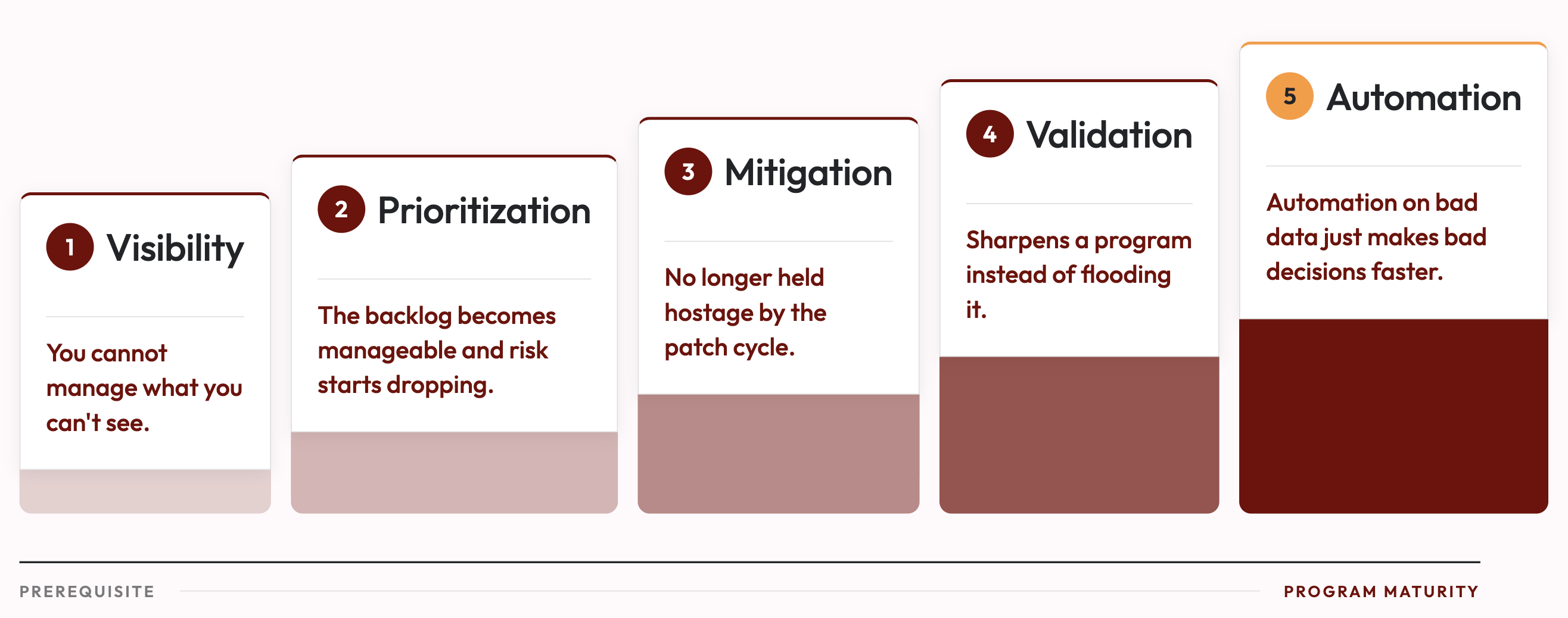
The most common mistake is buying out of order. Here’s a maturity ladder that holds up in practice.
First, visibility. Get a unified, de-duplicated inventory of assets and vulnerabilities, including your external attack surface. You cannot manage what you can't see.
Second, context-based prioritization. Stop triaging by CVSS. Layer in reachability, runtime presence, active exploitation, asset criticality, and existing controls. This is where the backlog becomes manageable and where leadership starts seeing risk drop.
Third, mitigation. Build the habit of reducing exploitability through controls you already own, so you're not held hostage by the patch cycle.
Fourth, validation. Once discovery and prioritization are solid, layer BAS or the broader AEV category to prove exploitability and test control efficacy. Now validation sharpens a program instead of flooding it.
Fifth, automation. Only once you trust your context and your validation should you hand parts of the loop to autonomous action. Automation on top of unreliable data just makes bad decisions faster.
Match each rung to the team that owns it, and don't let a vendor talk you up the ladder faster than your program can absorb.
As a program matures, the bottleneck stops being any single stage and becomes the handoffs between them. The scanner hands off to the prioritization tool, which hands off to a ticket, which hands off to a validation exercise. Context leaks at every seam. This is the gap the Unified Exposure Management Platform (UEMP) category exists to close, by running discovery, prioritization, validation, and action in one workflow.
Zafran is one platform in that category. It aggregates findings from the tools you already run, applies control-aware context to show what's actually exploitable, and can push mitigations to your existing defenses ahead of the patch. Depending on your stack, that either consolidates several point tools or makes the ones you keep more effective. The point for this guide isn't the vendor; it's that consolidating the lifecycle is itself a maturity step, and worth evaluating once your program has the fundamentals in place.
Keep the real goal in front of you the whole way: a program that continuously reduces risk, measured honestly. Use CTEM as the map, understand that EASM and BAS strengthen specific stages, and adopt each capability in the order your program can actually use it. Buy tools to fill the stage you're standing on, not the one three rungs up. Do that, and the alphabet soup turns back into what it always was: a set of capabilities in service of a program that measures risk reduced, not activity logged.
Traditional vulnerability management must change. So many are drowning in detections, and still lack insights. The time-to-exploit window sits at 5 days. Implementing a Continuous Threat Exposure Management (CTEM) program is the path forward. Moving from vulnerability management to CTEM doesn't have to be complicated. This guide outlines steps you can take to begin, continue, or refine your CTEM journey.