Blog
Amir Shavitt
Zafran and Athena: Turning the First Wave of AI-Discovered Vulnerabilities into Protection
September 29, 2026
Frontier AI can now chain exploits in minutes, not months. Zafran Attack Chain Killswitch pinpoints the threats that matter and the 𝘀𝗶𝗻𝗴𝗹𝗲 𝗮𝗰𝘁𝗶𝗼𝗻 that 𝗰𝗼𝗹𝗹𝗮𝗽𝘀𝗲𝘀 the most risk
Frontier AI isn't just changing the speed and scale of attacks, it's also changing the sophistication of exploitation. For years, attackers chased the one high-severity vulnerability everyone had to drop everything for.
Attackers moved on, stringing together the low and medium severity flaws that scanners wave through, turning that overlooked path into a route straight to your crown jewels. Exploits that used to take months to chain together are now assembled in minutes. A forgotten misconfiguration. An unpatched library. An over-permissioned role. Alone, each one reads as noise. Chained together, they become the breach.
That shift breaks the patch-everything model. When any low or medium flaw can be the link that completes a path, a list ranked by severity stops telling you where the real risk lives.
Keeping pace takes a different vantage point. You need a single view that follows an attacker across cloud and on-prem, the way they actually move. You need to know which campaigns adversaries are actually running right now. And you need to break the chain today, using the controls you already own, well before a patch and a maintenance window come around.
Zafran's Attack Chains shows you exactly how an attacker would move through your hybrid environment, mapping every real path from an exposed foothold to your crown jewels and surfacing the single action that breaks the most paths at once.
Attack Chains is built in collaboration with Google Threat Intelligence, the AI-driven, dynamic intelligence platform from Google Cloud that brings together Mandiant frontline expertise, the VirusTotal malware corpus, and Google's vast visibility. Zafran pulls in Google Threat Intelligence data to see how adversaries are operating across the internet, a global picture drawn from real adversary activity, then grounds that picture in your own environment and drives it toward action.
It answers the question every team asks when a new campaign surfaces: could this reach us?

Attack Chains ingests external threat data alongside Google Threat Intelligence, surfaces zero-days and chained CVEs as findings, and scores every chain so the ones that matter rise to the top. What sets it apart is the source. Through Google Threat Intelligence, the chains are built from real Mandiant investigations and what is being exploited in the wild right now, not AI heuristics reasoning about other AI heuristics. And because Google Threat Intelligence keeps that picture current, a campaign Mandiant is tracking this week is in your graph this week.
Attack Chains renders a full attack graph across your hybrid environment, cloud and on-prem, on one canvas. Most tools see one layer at a time, which is exactly how chained attacks slip through. Attack Chains follows the whole multi-hop path, from an internet-facing flaw to a cloud pivot to lateral movement into the on-prem assets that matter most, enriching each step with the TTPs, threat actors, and campaigns behind it.
Once the path is mapped, Attack Chains finds the choke point where the chain breaks, and gives you two ways to act on it. Mitigation is the fast path: a compensating control, like a WAF rule, applied in a few clicks, blocks the attack path at the choke point and closes the exposure window immediately. Remediation is the alternative fix: a patch or upgrade that closes the underlying CVE itself. Choose to remediate, and Zafran creates a Work Item that routes automatically to the right owner in your ITSM or ticketing tool for a frictionless handoff.

The real leverage is the ranking underneath it. Zafran scores every chain, works out what would break each one, and surfaces the single action that breaks the most chains at once. Instead of chasing hundreds of findings, your team applies the few controls that collapse the most risk.
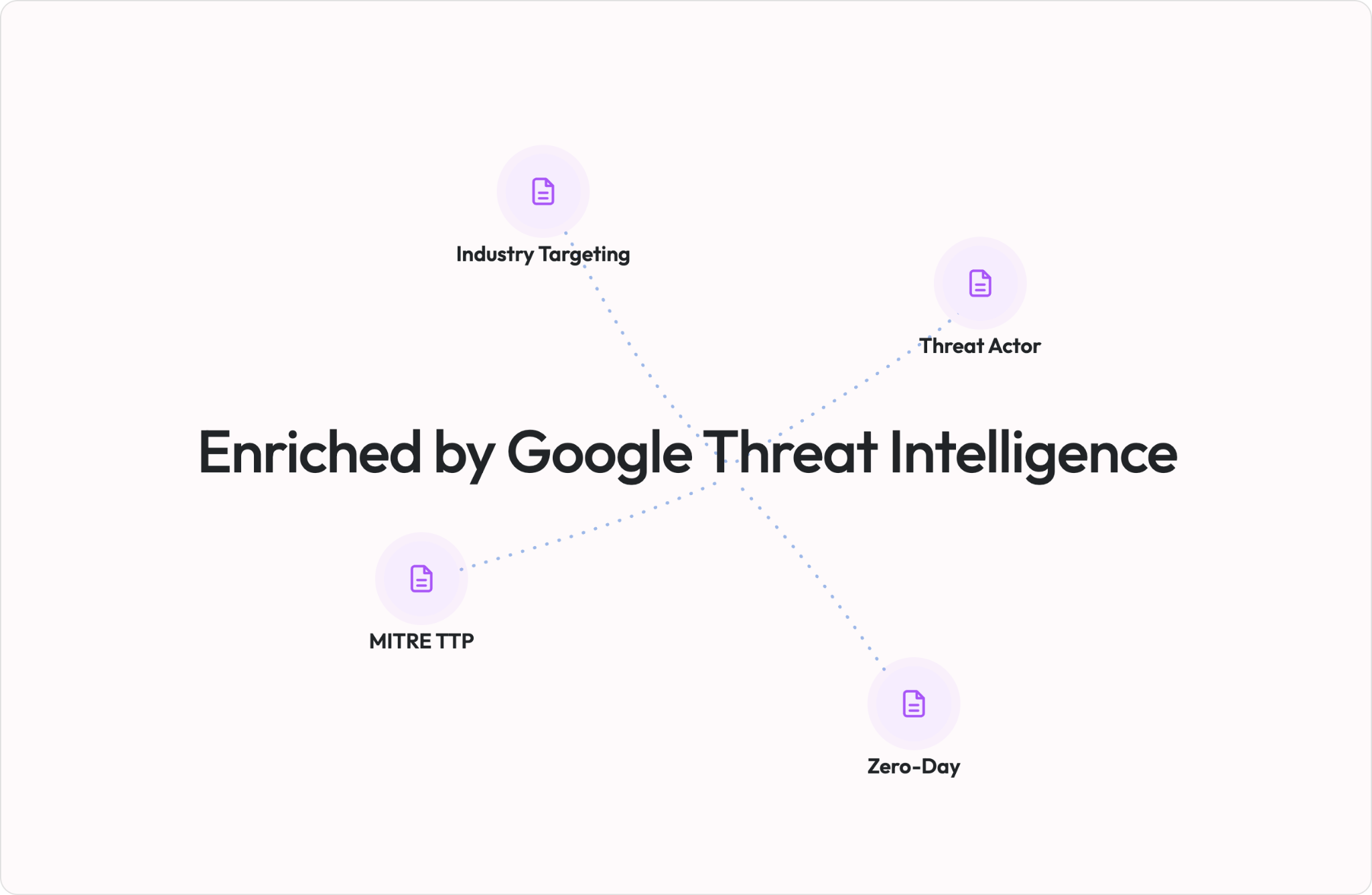
Google Threat Intelligence is what connects an exposure in your environment to a real adversary in the world. Chains are built from actual Google Threat Intelligence and Mandiant-tracked campaigns, each link carrying its exploited-in-the-wild and zero-day status and tied back to the specific threat actors running it. Google Threat Intelligence even maps CVEs to the industries they are hitting, so you know whether a path is striking organizations like yours. And when you move to break a chain, it supplies the SIEM and EDR indicators your existing controls need to detect and disrupt each link. The result is threat context that makes every attack chain more relevant, more explainable, and more actionable.
AI has changed the speed of the attack. It has not changed the fundamentals of defense-in-depth, and it cannot outsmart or outpace a layered defense that knows exactly where to act. That is the advantage this partnership delivers. Google Threat Intelligence provides the global view of how adversaries operate. Zafran grounds it in your environment and your existing controls, and drives it into immediate action. Together they can let you see every chain before the attack runs, find the choke point that matters most, and break many chains at once.
Traditional vulnerability management must change. So many are drowning in detections, and still lack insights. The time-to-exploit window sits at 5 days. Implementing a Continuous Threat Exposure Management (CTEM) program is the path forward. Moving from vulnerability management to CTEM doesn't have to be complicated. This guide outlines steps you can take to begin, continue, or refine your CTEM journey.