Blog
Jules Gross
Agentic Asset Ownership: Automating for Faster Remediation
September 1, 2026
Zafran has been recognized in two recent Gartner Emerging Tech reports, in our view charting the shift toward preemptive cybersecurity.
Zafran has been recognized in two recent Gartner Emerging Tech reports, in our view charting the shift toward preemptive cybersecurity.
Zafran was named a Sample Vendor for Autonomous Exposure Remediation in Emerging Tech Impact Radar: Preemptive Cybersecurity, published 11 September 2026. Zafran was also identified among the funded startups in the Unified Exposure Management Platform category in Emerging Tech: Top Funded Startups for Preemptive Exposure Management, published 3 April 2026.
Two categories, one underlying shift. Exposure management is becoming preemptive, because AI has made the old pace of finding and fixing untenable.
Gartner defines Autonomous Exposure Remediation as follows:
“Autonomous exposure remediation (AER) uses generative AI to orchestrate fully autonomous, closed-loop remediation at scale. It proactively generates, validates, and deploys security fixes across code, supply chain, and infrastructure. AER shifts security from reactive, manual patching to a preemptive discipline, neutralizing threats at machine speed while integrating with CI/CD pipelines for safe, auditable implementation.”
And Unified Exposure Management Platforms:
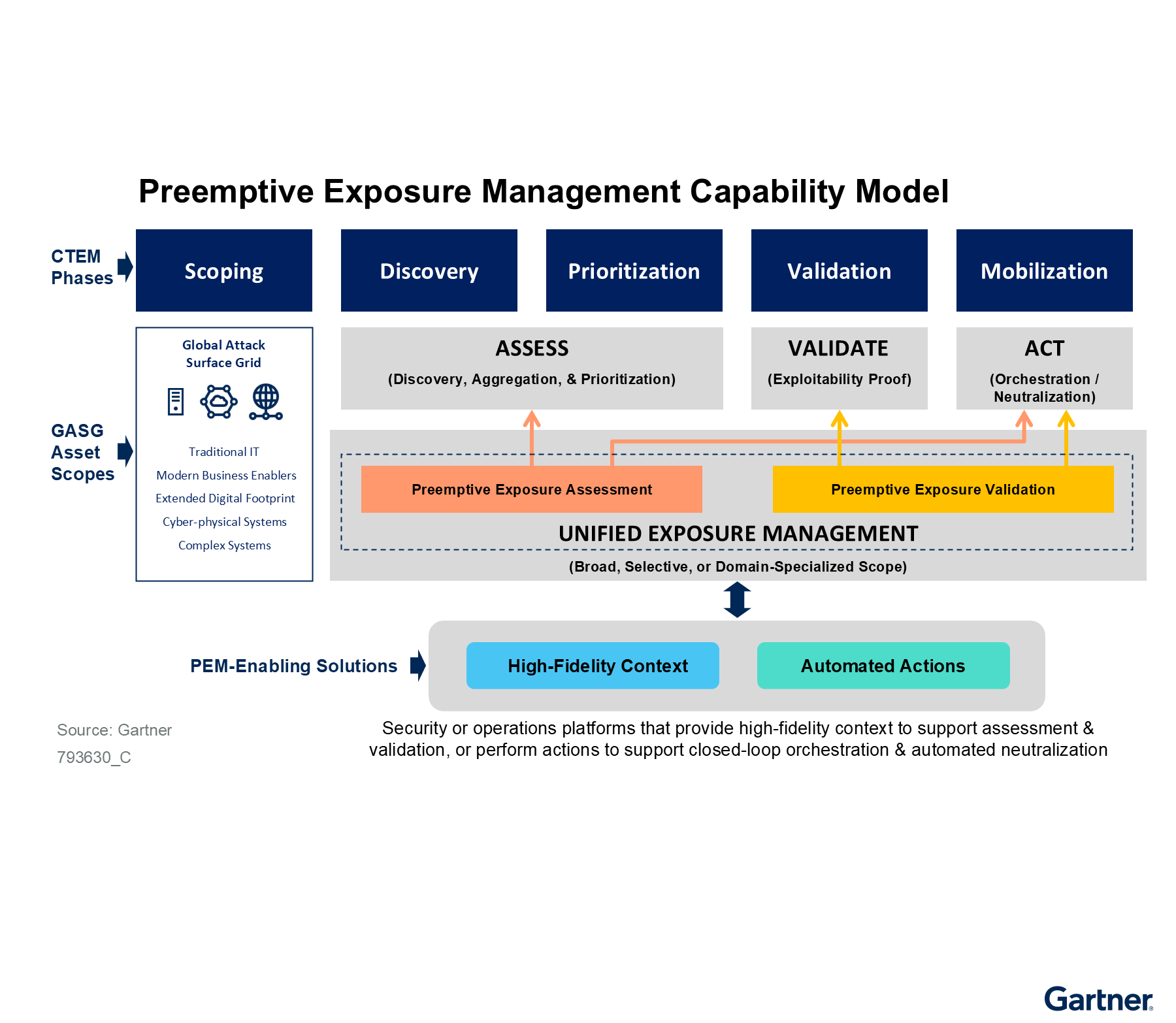
“Unified exposure management platforms (UEMPs) unify the functions of discovery and contextual prioritization, active and/or passive exposure validation that provides technical or functional evidence of exploitability, and automated or orchestrated risk mitigation within a single platform. UEMPs are essential for adopting a preemptive security strategy as they enable organizations to embed more end-to-end exposure management automation to neutralize exposures before adversaries can exploit them.”
Source: Gartner, Emerging Tech Impact Radar: Preemptive Cybersecurity, Elizabeth Kim, 11 September 2026.
The scale of investment tells the story.
“Gartner’s research focused on 148 startups in the preemptive exposure management space that secured venture capital (VC) funding between March 2023 and March 2026. The focus was intentional to illustrate indicators of preemptive exposure management growth and investment. Collectively, these vendors represent approximately $4.19 billion in VC investment during this period.”
Source: Gartner, Emerging Tech: Top Funded Startups for Preemptive Exposure Management, Luis Castillo, Elizabeth Kim, 3 April 2026.
Gartner’s forward-looking view is more pointed still:
“By 2028, at least half of the exposure management market will consist of unified exposure management platforms (UEMPs) — up from less than 5% in 2025 — driven by the need to consolidate fragmented security data and unify siloed exposure management processes.”
“By 2030, over 50% of exposure management solutions will natively deliver autonomous validation and mitigation — up from less than 10% today — marking a decisive industry shift from passive risk identification to preemptive risk neutralization.”
Source: Gartner, Emerging Tech: Top Funded Startups for Preemptive Exposure Management, Luis Castillo, Elizabeth Kim, 3 April 2026.
For twenty years, vulnerability management ran on a rhythm that assumed time existed. A CVE gets published. A scanner picks it up on its next cycle. An analyst triages it. A ticket gets filed. It enters a change window. Somewhere between two weeks and two quarters later, a patch lands.
That rhythm was built for an adversary who also needed time. Writing a working exploit took skill and effort, and defenders could count on a buffer between disclosure and weaponization.
AI has collapsed the economics of offense. Frontier models and agentic tooling let attackers discover weaknesses, write working exploits, and chain unrelated low-severity findings into functional attack paths at machine speed. A remediation process measured in weeks is now competing against an exploitation cycle measured in hours.
You cannot out-triage that. Adding headcount to a queue that grows faster than it drains produces a bigger queue. Better prioritization helps, though ranking findings you still cannot act on quickly enough only tells you which breach to expect first.
Proactive means looking ahead: scanning more often, scoring more accurately, forecasting what might be targeted. The output is still information for a human to act on later. Preemptive moves the action itself earlier, closing the exposure before exploitation is possible. That takes knowing which exposures are genuinely exploitable in your environment, proving a fix will not break production, and executing without waiting on a human to approve every step.
Most organizations do not need a new control to close most exposures. They need to use the controls already deployed.
Zafran’s analysis found that roughly 90% of vulnerabilities can be effectively mitigated using controls organizations already have in place. The firewall, the EDR, the identity provider, the WAF: each can be reconfigured to neutralize a specific exploitation path in hours, while the permanent patch takes its normal course through change management.
Security teams have the capability. What they lack is a way to see it. Human-speed security operations cannot assess which of the 40,000 findings from last week’s scan is already blocked by an EDR policy, which is unreachable because the service is not running, and which sits behind a firewall rule that could be tightened this afternoon.
That is what Zafran’s AI-native Exposure Graph exists to solve. The platform aggregates findings from the tools customers already run and adds native visibility through the Zafran Detector, then correlates every finding against the defensive controls actually deployed in that environment, along with runtime presence, internet exposure, active exploitation, and business context. Most findings labeled critical turn out to be noise once that context is applied. What remains is a short, real list.
Finding the exposure is the shorter half of the job. Closing it is where programs stall, on ownership debates, uncertain exploitability, conflicting severity ratings, and ticket cycles that outlast the risk itself.
Agentic Remediation is built for that stall. When the Exposure Graph surfaces a zero-day exposure or a high-risk vulnerability, an agent validates exploitability against live environmental signals: whether the vulnerability is reachable, whether compensating controls already neutralize it, whether runtime behavior shows the component in use, and whether the asset sits on an exposed network path.
What happens next follows from that answer. Findings that turn out not to be exploitable are marked as false positives with the supporting evidence attached. Where the business chooses to accept the risk, the agent generates a risk acceptance report carrying justification, residual risk, and references, standardizing a process that used to vary case by case.
Where action is required, the agent identifies the asset owner from live signals rather than a stale CMDB field, drawing on last-login traces from EDR, OS-level traces, cloud IAM relationships, naming conventions, and change-management history. It then models the impact of the patch, covering dependencies, service relationships, blast radius, and expected downtime, so teams know what a fix touches before it runs. From there it drives an automated patch, a remediation plan with the ticket assigned in Jira, Slack, or ServiceNow, or a mitigation playbook. Reporting and dashboards close the loop with timestamped, evidence-backed records.
In our view, that closed loop from validated exploitability through to a verified fix is the capability Zafran has been building towards.
From there, Zafran identifies the choke points where multiple attack paths converge and pushes validated mitigation policies into existing controls to defuse the exposure before exploitation. The platform models the operational impact of every change before it is applied, so teams can move fast without breaking production.
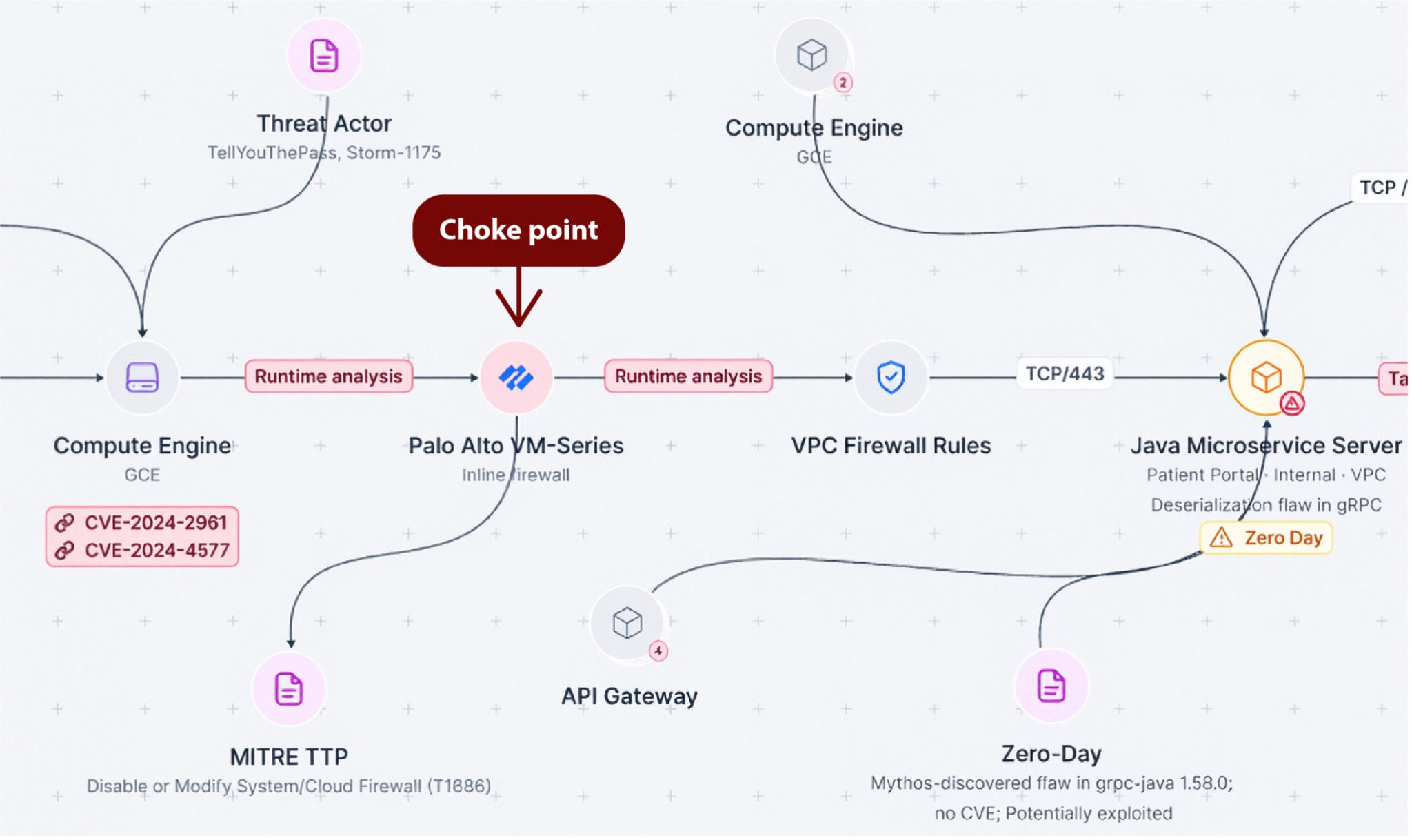
In our view, that end-to-end span is the whole point. Assessment without action produces reports. Action without validated context produces outages. Zafran was built on the conviction that the two have to be one system, and the market is now converging on that position.
Gartner, Emerging Tech Impact Radar: Preemptive Cybersecurity, Elizabeth Kim, 11 September 2026.
Gartner, Emerging Tech: Top Funded Startups for Preemptive Exposure Management, Luis Castillo, Elizabeth Kim, 3 April 2026.
Gartner does not endorse any company, vendor, product or service depicted in its publications, and does not advise technology users to select only those vendors with the highest ratings or other designation. Gartner publications consist of the opinions of Gartner’s business and technology insights organization and should not be construed as statements of fact. Gartner disclaims all warranties, expressed or implied, with respect to this publication, including any warranties of merchantability or fitness for a particular purpose.
GARTNER is a trademark of Gartner, Inc. and/or its affiliates.
Traditional vulnerability management must change. So many are drowning in detections, and still lack insights. The time-to-exploit window sits at 5 days. Implementing a Continuous Threat Exposure Management (CTEM) program is the path forward. Moving from vulnerability management to CTEM doesn't have to be complicated. This guide outlines steps you can take to begin, continue, or refine your CTEM journey.