
Zafran Announces Offensive Validation to Prevent Exposure Ahead of AI Attackers

Read More
Zafran Research

The 2026 State of Threat Exposure Management

Frontier AI: Real Risk, More Noise, and Less Time to Act

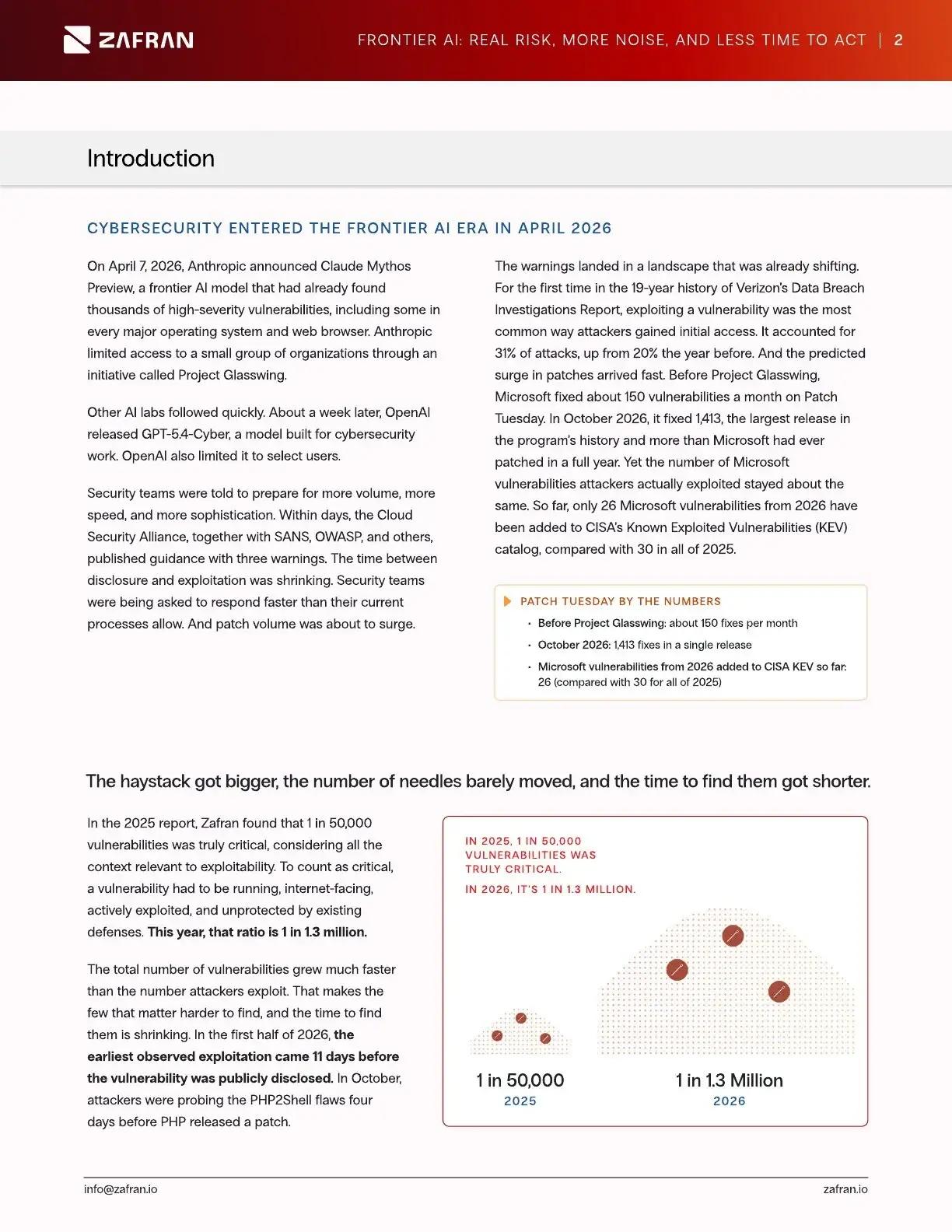
Vulnerability disclosures surged. Fewer than 1 in a million is truly critical, and the fastest attackers struck 11 days before disclosure.

Get the Report

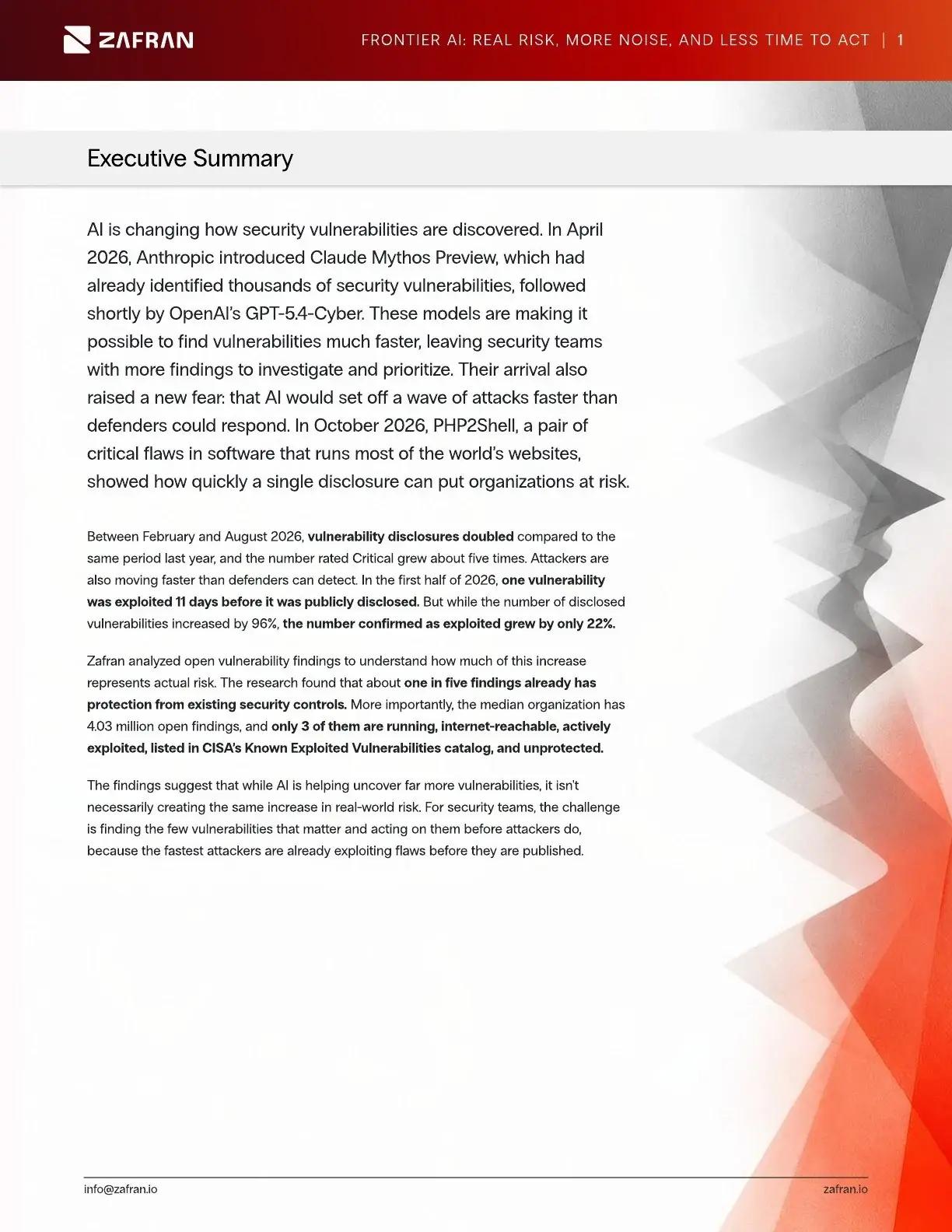
Security teams are working through twice as many disclosures as a year ago. Zafran Research analyzed public vulnerability data and open findings across our customers to show how much of that growth is real risk, how fast attackers are moving, and where to focus first.

What’s inside

  • 1 in 1.3 million The share of open findings that is truly critical, down from 1 in 50,000 in last year’s report
  • 11 days How long before disclosure attackers began exploiting one vulnerability, and what PHP2Shell showed
  • 4 actions What your team can do now to find and fix the few findings that matter
Page 1 of the report: the cover, The 2026 State of Threat Exposure Management
Page 1 of 18

Read the 2026 report

Four questions, four findings and four actions, based on public vulnerability data and open findings across Zafran customer environments.

This report is for you if you:

  • Face a backlog of millions of findings and need a defensible way to decide what gets fixed first

  • Have a board asking whether AI-driven discovery means more real risk

  • Want to see how your vulnerability management program compares with others in the post‑Mythos world

Four findings from the 2026 data

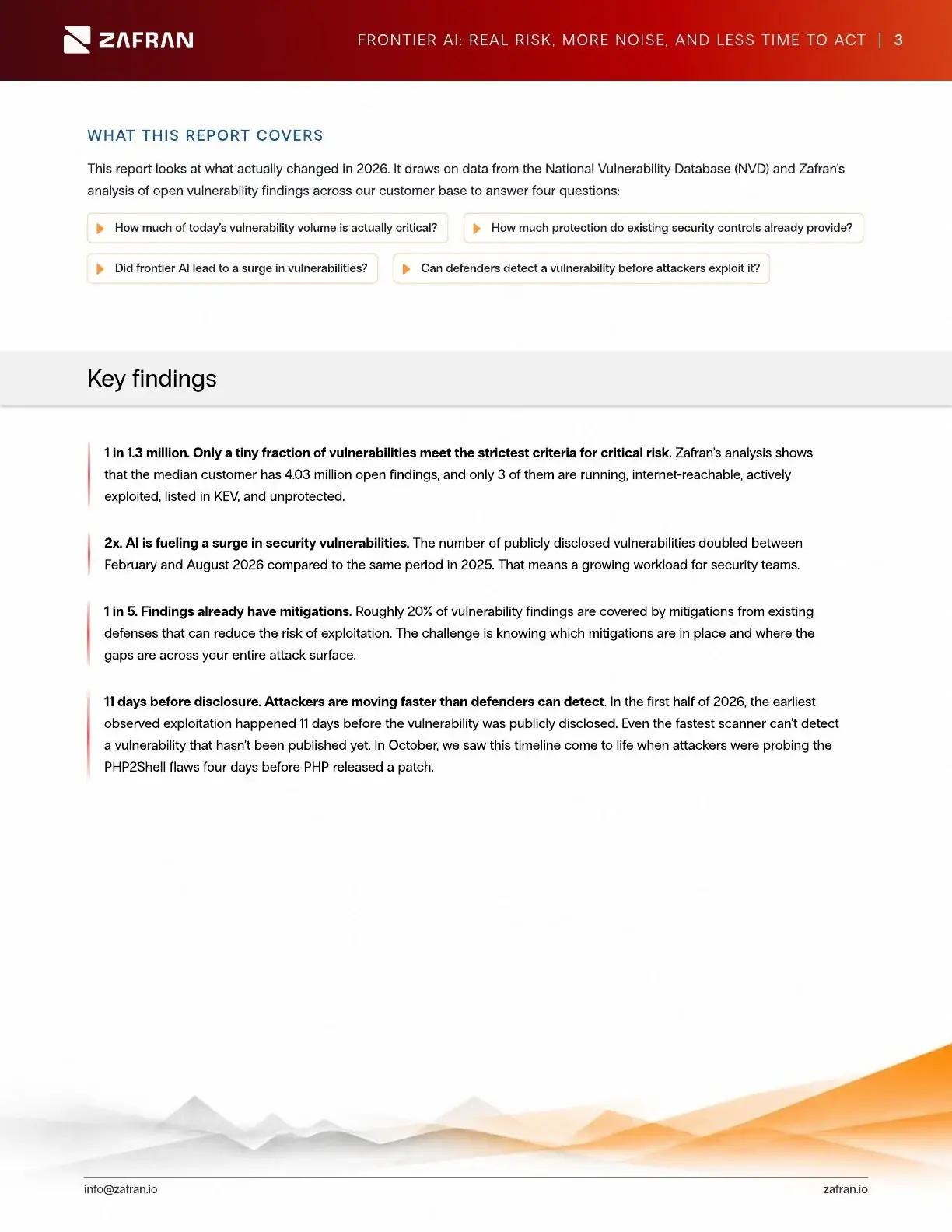
1 in 1.3 million

The median customer has 4.03 million open findings. Only 3 are running, internet-reachable, actively exploited, listed in CISA KEV and unprotected. In 2025, Zafran found that 1 in 50,000 vulnerabilities was truly critical.

Open findings 4.03 million

Truly critical 3

1 in 1.3 million
  1. All open findings 4.03 million
  2. Running 1.22 million
  3. Running and internet-reachable 1,770
  4. Exploited in the wild 6
  5. Listed in CISA KEV 5
  6. No compensating control (truly critical) 3
Open findings for the median Zafran customer at each condition. Funnel widths are illustrative. Source: Zafran Research.
Data behind the chart
ConditionOpen findings
All open findings4.03 million
Running1.22 million
Running and internet-reachable1,770
Exploited in the wild6
Listed in CISA KEV5
No compensating control (truly critical)3

2x disclosures, 22% more exploitation

Between February and August 2026, disclosures grew 96% over the same period in 2025. Vulnerabilities confirmed as exploited grew about 22%.

Disclosed (NVD) +96%

Exploited (CISA KEV) +22%

Disclosed (NVD)
2025 27,872 2026 54,621
Exploited (CISA KEV)
2025 167 2026 203
Growth from 2025 to 2026, indexed so 2025 = 100. Source: NVD, February to August; CISA KEV, January to August.
Data behind the chart
Measure20252026Change
Disclosed (NVD)27,87254,621+96%
Exploited (CISA KEV)167203+22%

1 in 5 findings already has a control

About 19.9% of open findings have a control that reduces risk. On running, internet-reachable findings that falls to 2.4%.

  • All open findings 19.9%

  • Running and internet-reachable 2.4%

  • Running, reachable and exploited 4.6%

Out of every 100 findings, how many have a security control that reduces risk? Source: Zafran Research.
Data behind the chart
Group of findingsShare with a control
All open findings19.9%
Running and internet-reachable2.4%
Running, reachable and exploited4.6%

11 days before disclosure

In the first half of 2026, the earliest observed exploitation came 11 days before the vulnerability was published. PHP2Shell probing began four days before the patch.

From first attack to typical detection 14 days

Day −11 Fastest observed exploitation Day +3 Typical scanner reports it
Day 0 Published
First half of 2026: fastest observed exploitation versus typical scanner detection. Source: Zafran Research.
Data behind the chart
EventDay relative to publication
Fastest observed exploitationDay -11
Vulnerability publishedDay 0
Typical scanner reports itDay +3

Four questions the report answers

The report draws on data from the National Vulnerability Database (NVD) and Zafran’s analysis of open vulnerability findings across its customer base.

Very little. The median customer has 4.03 million open findings. Only 3 of them are truly critical, or about 1 in 1.3 million. In the 2025 report the ratio was 1 in 50,000.

The evidence points to yes. From February through August 2026, NVD published 54,621 CVEs, double the 27,872 published in the same period of 2025. At vendors using AI-assisted discovery, monthly disclosures rose anywhere from three to nearly 19 times their rate before frontier AI models.

Roughly 1 in 5 open findings (19.9%) has a security control that reduces its risk. On findings in running, internet-reachable software, the share falls to 2.4%.

Not reliably. The typical time for a scanner to report a known exploited vulnerability dropped from 38 days in early 2024 to 3 days in 2026. In the first half of 2026, the fastest observed exploitation still came 11 days before the vulnerability was published.

Four actions to take first

  1. Use context to sort findings

    Check whether each vulnerability is running, reachable, exploited and already covered by a control.

  2. Configure the defense tools you own

    Confirm CVE-specific protections are enabled, starting with controls in front of internet-facing systems.

  3. Know your scanners

    Measure how fast each one reports new vulnerabilities, and use more than one source of detection.

  4. Plan for flaws that won’t get a patch

    Identify legacy and end-of-life systems and decide how to protect them.

See your own numbers

Find out how many of your findings are truly critical and where PHP2Shell can reach your environment.

Book a Demo