Health-ISAC warned that AI models like Anthropic’s Mythos would make it faster and easier to find and exploit flaws in the software hospitals depend on. In October, Epic, the electronic health record vendor used by hospitals across the US, turned that warning into reality. As part of Anthropic’s Project Glasswing, Epic used Mythos to find flaws in its own software and told the hospitals running it to expect more urgent patches, which each hospital has to deploy itself.
Health-ISAC’s warning matters because it explains what Epic’s findings mean for hospital security teams: more urgent patches, less time to deploy them, and more systems that can’t be patched on schedule.
Health-ISAC’s CEO put it plainly:
“Healthcare CISOs and security teams need to understand that with Mythos, the speed of vulnerability detection and exploitation will be increased exponentially. Companies will need to lean more heavily into moving off legacy systems whenever possible and continue to develop and implement mitigating controls around third-party tools and legacy systems.”
Epic’s Mythos findings showed the warning was right
Epic, whose electronic health record software and MyChart patient portal are used by hospitals and physician offices across the US, has paused most of its product development to fix security flaws that Anthropic’s Mythos model found in its software. Epic’s chief security officer, Stirling Martin, said that some customer configurations of MyChart could let outsiders view patient records without the access showing up in the logs. Epic has already told customers to expect more urgent patches than usual.
As a member of Anthropic’s Project Glasswing, Epic confirmed at its August user group meeting that it uses Mythos heavily. Martin said Epic pointed the model at its own codebase and found weaknesses that Epic’s own developers had missed. Martin added that newer models are getting better at chaining unrelated weaknesses into attack paths.
The most serious findings involve MyChart. Epic hasn’t released technical details about the flaws, and it’s still unclear whether an attacker could also change records without being detected. Martin said that would depend on other technology, not necessarily Epic’s, and that the risk was serious enough to fix either way.
MyChart holds more than 320 million patient records, but Epic doesn’t store them. Each hospital or physician practice runs its own MyChart setup and keeps its own patient data. Because the flaw shows up only in certain configurations, each provider has to check how its own system is set up and install Epic’s fixes itself. Epic can write the patch, but the hospital has to deploy it. That’s why Martin said a 30-day patching target is no longer enough, and Epic has started giving hospitals that host their own Epic systems guidance on how to speed up their patch schedules.
What this means for healthcare security teams
Martin’s warning that 30 days is too slow means hospital security teams have less time to find affected systems, test fixes, and get them into production.
As AI-assisted testing spreads, health systems should expect more urgent fixes from their software vendors and device makers, and some systems won’t be able to take those fixes right away. In an October 15 op-ed, Health-ISAC’s Phil Englert and Simon Cowley explained that many medical devices cannot be patched like an office laptop. The hospital often waits for the manufacturer to validate a patch for patient safety, then needs a window to take the device out of service.
Advice from Health-ISAC
In an October 13 webinar, speakers from security firm Bishop Fox, a Health-ISAC Community Services Champion, shared advice for handling urgent patches that can’t be deployed right away. The steps below draw on their recommendations:
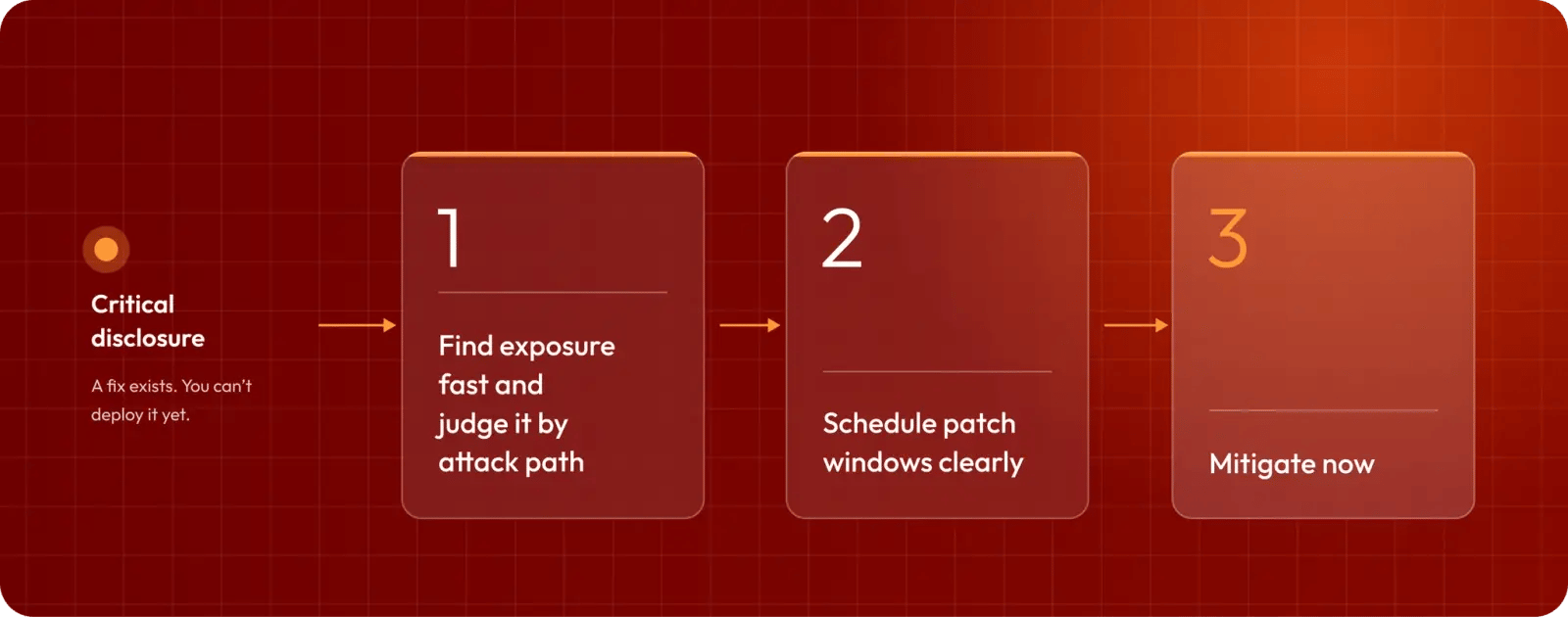
- Find exposure fast and judge it by attack path. Aim to identify affected assets within hours of a major disclosure, and look past severity labels: a low-risk flaw can be the first step in an attack chain.
- Schedule patch windows clearly. Agree with clinical leaders in advance on change approvals and downtime windows, so urgent fixes have a set path into production.
- For systems that can’t be patched soon, mitigate now. Shield, segment, or restrict what those systems can reach while the fix is scheduled.
How Zafran helps health systems get ahead of urgent fixes
Zafran helps healthcare security teams get ahead of the patch clock by preventing exploits before a fix is deployed. It brings visibility, prioritization, and action into one workflow, so your team can find what’s affected, see which flaws lead to critical systems, and protect patient systems while waiting on a patch.
- Find exposures fast. Zafran pulls findings from the scanners, EDR, and firewalls you already run into one deduplicated view. When a new threat emerges, the Zero Day Agent correlates threat intelligence against SBOM data to find affected assets in your environment, including threats that don’t have a CVE yet.
- Judge exposures by attack path. Zafran maps how an attacker could move from an entry point to a critical system, so your team can see when a low-severity flaw is the first step in an attack chain. It then finds the chokepoints where a single mitigation breaks several attack chains at once, before attackers can use them.
- Prioritize what is exploitable. Every finding is enriched with runtime presence, internet exposure, active threat intelligence, business criticality, and compensating control coverage, then mapped on the Exposure Graph so your team fixes the exposures attackers can reach and exploit first.
- Protect devices and systems you can’t patch. Many medical devices wait months for a manufacturer-validated patch, and end-of-life systems will never get one. Zafran maps each exposure on these assets to the controls already in your environment, such as firewall rules, segmentation, and EDR policies, and with your approval pushes the changes that block the attack path. When a patch does arrive, Zafran creates high-fidelity tickets with detailed remediation steps and assigns owners.


Preventing exploits before the next patch arrives
Health-ISAC warned that AI would speed up how quickly flaws are found and exploited, and Epic’s Mythos findings proved it in the software hospitals rely on most. More software vendors and device makers will ship urgent fixes of their own, and hospital security teams won’t be able to patch everything on a 30-day clock.
The teams that get ahead will find affected assets within hours, focus on the attack paths that reach critical systems, and use compensating controls to protect what they can’t patch yet. Zafran helps healthcare security teams do all three, so they can prevent exploits before the next urgent patch arrives.
- The New York Times: report on Epic and Mythos (Sept 30, 2026)
- Becker's Hospital Review: Epic's cybersecurity push, 6 things to know (Oct 5, 2026)
- TechCrunch: Medical records giant Epic pauses product development to fix security bugs (Oct 2, 2026)
- Health-ISAC: Mythos-Like AI Tools Raising Healthcare Cyber Stakes
- Health-ISAC Op-Ed: When a hospital can't patch a machine, what's the backup plan? (Oct 15, 2026)
- Bishop Fox webinar: Beyond the Hype: What Mythos Actually Means for Security Teams (Oct 13, 2026)